
Company context & accountability
Maintain people, units, locations, and operating countries. Link business activities to responsible people, assets, and documents; a person can be recorded without a login.
ITQAN · GOVERNANCE, RISK & COMPLIANCE
Bring policies, risk decisions, and compliance evidence into one workspace. Know who owns the work, what needs attention, and what comes next—with AI assistance.
THREE DISCIPLINES. ONE SHARED CONTEXT.
From people and policies to assets and risk, then requirements and their evidence. Purpose-built capabilities. Connected work.
Give your team a shared view of the company, its policies, and the people responsible for delivery and review.
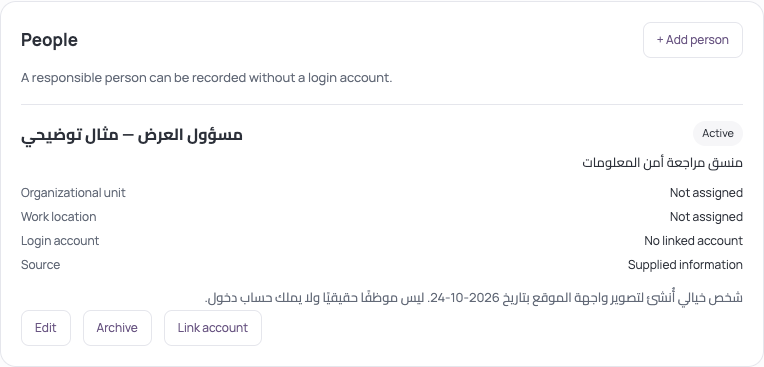
A detail from the real people directory with a fictional demonstration person. Responsibility is separate from login access.
Click to enlargeMaintain people, units, locations, and operating countries. Link business activities to responsible people, assets, and documents; a person can be recorded without a login.
Search policies, procedures, and standards by name or owner. Follow version links and recorded approval dates, review content quality, and prepare Word drafts where policy writing is enabled.
Set a goal, scope, team, and target dates. Assign task owners and reviewers, define completion criteria, collect evidence, and accept work or request changes.
Keep business responsibility separate from account access. Use role-based actions and saved action history; designated reviewers and authorized decision-makers retain their part in the process.
Connect what matters to the business with the threats, vulnerabilities, controls, and decisions that shape each risk scenario.

A fictional threat-to-asset example. The likelihood is an illustrative input; this screen is not a saved risk scenario or a calculated risk result.
Click to enlargeRecord classification, confidentiality, integrity, availability, owners, custodians, dependencies, and data residency. Import supported asset tables with row-level outcomes and keep unknown values visible.
Maintain threat and vulnerability catalogs, then link relevant entries and existing or proposed controls to affected assets. Use AI assistance to draft scenarios, review the proposal, and save the appropriate changes.
Review likelihood, impact, and vulnerability inputs and their recorded sources. The platform calculates the score and applies scope-specific appetite thresholds; AI suggestions remain identifiable.
Assign separate risk and treatment owners, record treatment actions and review dates, and retain the actor and time of acceptance or closure. Export the register, treatment plan, and methodology to Excel.
Understand the source, confirm the assessment scope, and keep reasons and missing evidence beside the result. Continue with the work your team needs to do next.
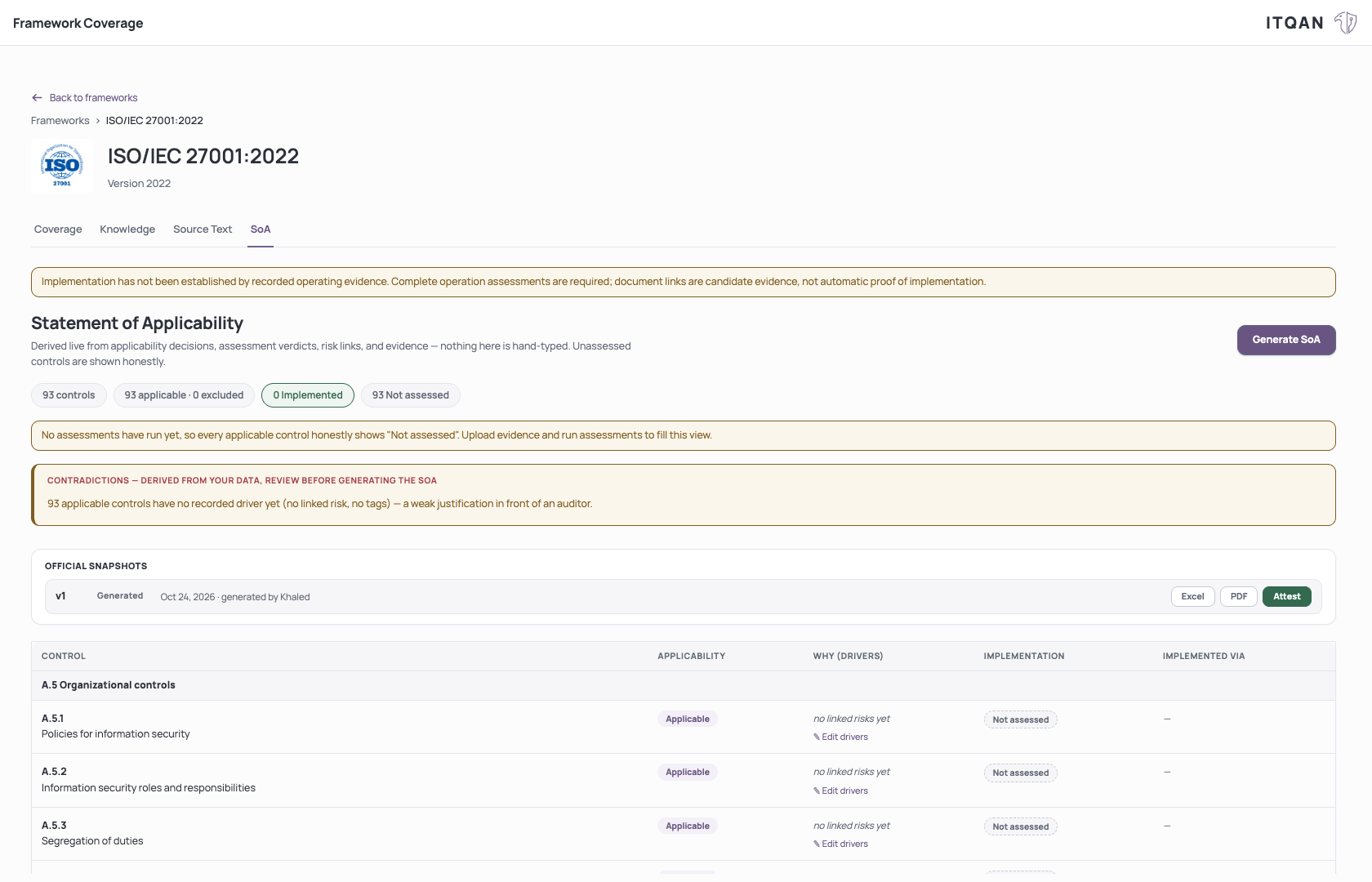
A generated, unattested SoA snapshot. Controls are shown as not assessed; the snapshot is not a certification or compliance result.
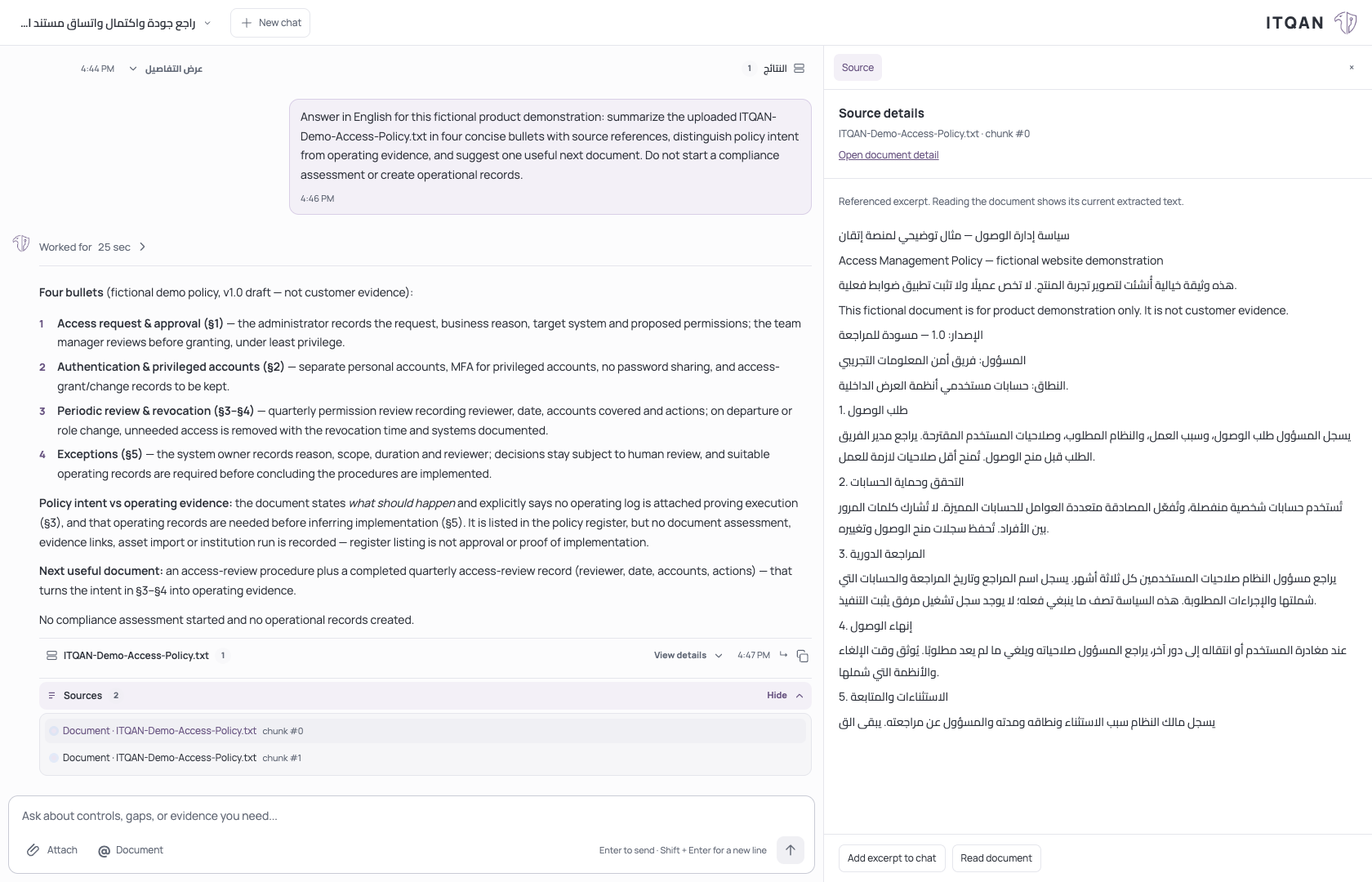
Click to enlargeRead supported files in Arabic and English, ask questions, and return to source excerpts. Keep reading limits and document quality review separate from assessment.
Explore international, Saudi, and Egyptian framework content with its available support. Review selected requirements and confirm scope before a supported assessment.
Read saved outcomes with reasons and source references. Supported institutional paths combine current evidence across documents; follow findings, request evidence, and retain review responses.
Prepare PDF and Excel gap reports and ISO Statements of Applicability with justifications and saved snapshots. Keep administrative attestation distinct from generation and external certification.
Each review retains its scope and owner. Saving a policy or completing a task alone does not establish compliance or reduced risk.
START WHERE YOUR WORK IS
Bring company context, policies, and delivery into a shared view. Know who contributes, who reviews, and what still needs attention.
See the capabilities ↗Connect the asset, threat, vulnerability, and controls. Review the scenario, evaluate it against your methodology, and assign treatment responsibility.
See the capabilities ↗Confirm supported requirements, understand the available evidence, and make missing information visible. Carry findings into follow-up work and share reviewable outputs.
See the capabilities ↗FROM UNDERSTANDING TO ACTION
Read, ask, and follow the source. Then choose the right use: a document review, a supported assessment, or a register import. Keep follow-up owned and results available to revisit.
Take the product tour — 5 chaptersTHE DETAILS THAT MAKE THE DIFFERENCE
International, Saudi, and Egyptian framework content, with a clear review path and support boundaries for each. Choose requirements that fit your company’s scope and operating context.
Explore the framework directoryRole-based actions, designated owners and reviewers, and recorded decisions. Understand your installation and AI provider configuration in the context of your company.
Security, deployment & permissionsCLARITY AT EVERY STEP
Uploading a file does not automatically mean a compliance assessment. Each use has a purpose, an output, and clear boundaries.
Governance connects company context, policies, responsibilities, projects, review, and access. Risk connects assets, threats, vulnerabilities, scoring, appetite, and treatment decisions. Compliance connects supported framework requirements with evidence, findings, reports, and ISO SoA. These records support related work; a completed task does not automatically prove compliance or lower a risk score.
Reading helps you understand the available document text. A quality review checks completeness and consistency. Assessment uses selected framework requirements and evidence. Import brings supported register rows into the workspace. You choose the work you need.
A policy can support a documentary requirement. Evidence of actual operation may need logs, records, samples, or other relevant sources. Missing operating evidence remains visible in supported assessment paths.
Supported document and assessment views include source excerpts and references. Available PDF and image reading locations help you return to the original. Reading limits and unavailable evidence remain relevant to the conclusion.
YOUR NEXT STEP
Bring your requirements. Explore the ITQAN workflow that fits your team.
